Horse head Nebula & Orion Nebula mosaic

Equipment
Exposure summary
Sky map
Hi  ,
,
I finally finished my winter project, which was a 3x2 mosaic of 3 main targets: the Horsehead Nebula, Flame Nebula, and Orion Nebula. I started shooting first light on Nov 28, 2025, but unfortunately, I rotated the camera poorly and the mosaic wouldn't have stitched together nicely, so the official imaging started on Dec 15. The worst part about winter was the rather unfavorable weather. Compared to winter 2024, which had quite a few cloudless days, this winter was cloudy almost all of December. Out of the whole month, I could only shoot on 3 days: the 15th, 18th, and 19th, and even on the last day of December, most of the night was covered in fog :(. I then continued with the project in January, which wasn't much better, but towards the end of the month, things worked out :).
In total, I managed to shoot on these nights: Dec 15, Dec 18, Dec 19, Jan 4, Jan 18, Jan 19, Jan 20, and Jan 21.
More specifically, here is the number of exposures for each panel:
Day   | Panel 1 60s | Panel 2 60s | Panel 3 10s | Panel 3 60s | Panel 4 60s | Panel 5 60s | Panel 6 10s | Panel 6 60s
---------------------------------------------------------------------------------------------------------------------
04.01 | 25          | 45          | 0           | 21          | 0           | 27          | 0           | 26
15.12 | 45          | 50          | 0           | 45          | 20          | 40          | 0           | 41
18.01 | 35          | 41          | 0           | 41          | 33          | 41          | 0           | 35
18.12 | 18          | 20          | 0           | 30          | 18          | 15          | 0           | 20
19.01 | 37          | 45          | 0           | 31          | 39          | 40          | 0           | 20
19.12 | 9           | 15          | 18          | 15          | 5           | 5           | 19          | 5
20.01 | 45          | 44          | 0           | 38          | 40          | 35          | 0           | 35
21.01 | 0           | 5           | 0           | 5           | 0           | 198         | 0           | 5
For panels 3 and 6, which is the Orion Nebula, I also took a few 10s exposures for HDR so the core wouldn't be blown out, which is why you can see it in all its glory :)
Because I have a low total number of hours overall—since I practically needed to shoot 6 targets at once—the signal-to-noise ratio wasn't great. After denoising, this also introduced a color gradient into the photo that I couldn't manage to remove :/ but even so, I'm happy with the photo (being my first mosaic) :)
Here is a timelapse from one of the nights, you can see how the telescope makes micro-movements and shoots the individual panels (first half): https://www.youtube.com/shorts/CtvzzOVEeqI
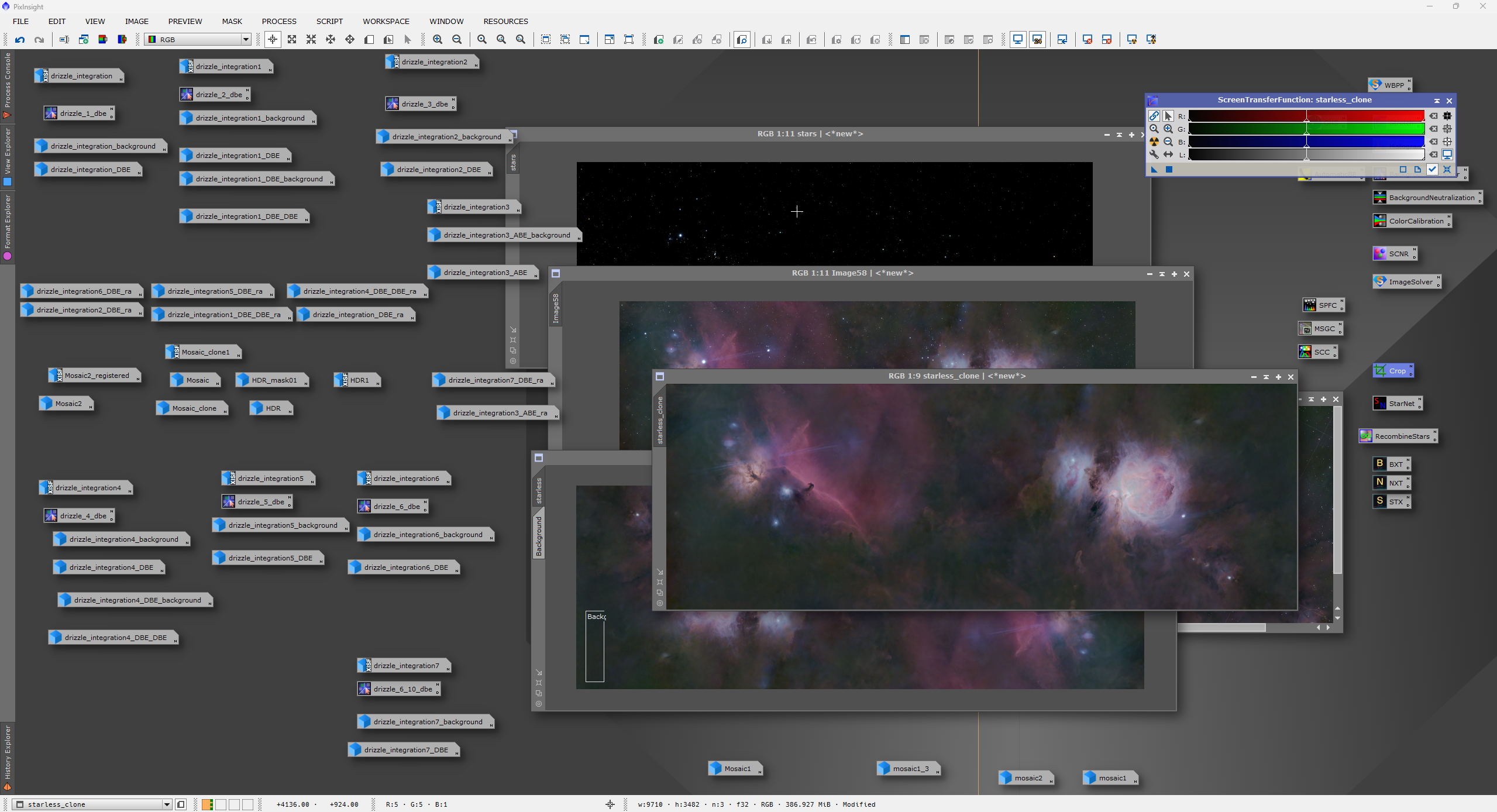
Btw this was my workspace
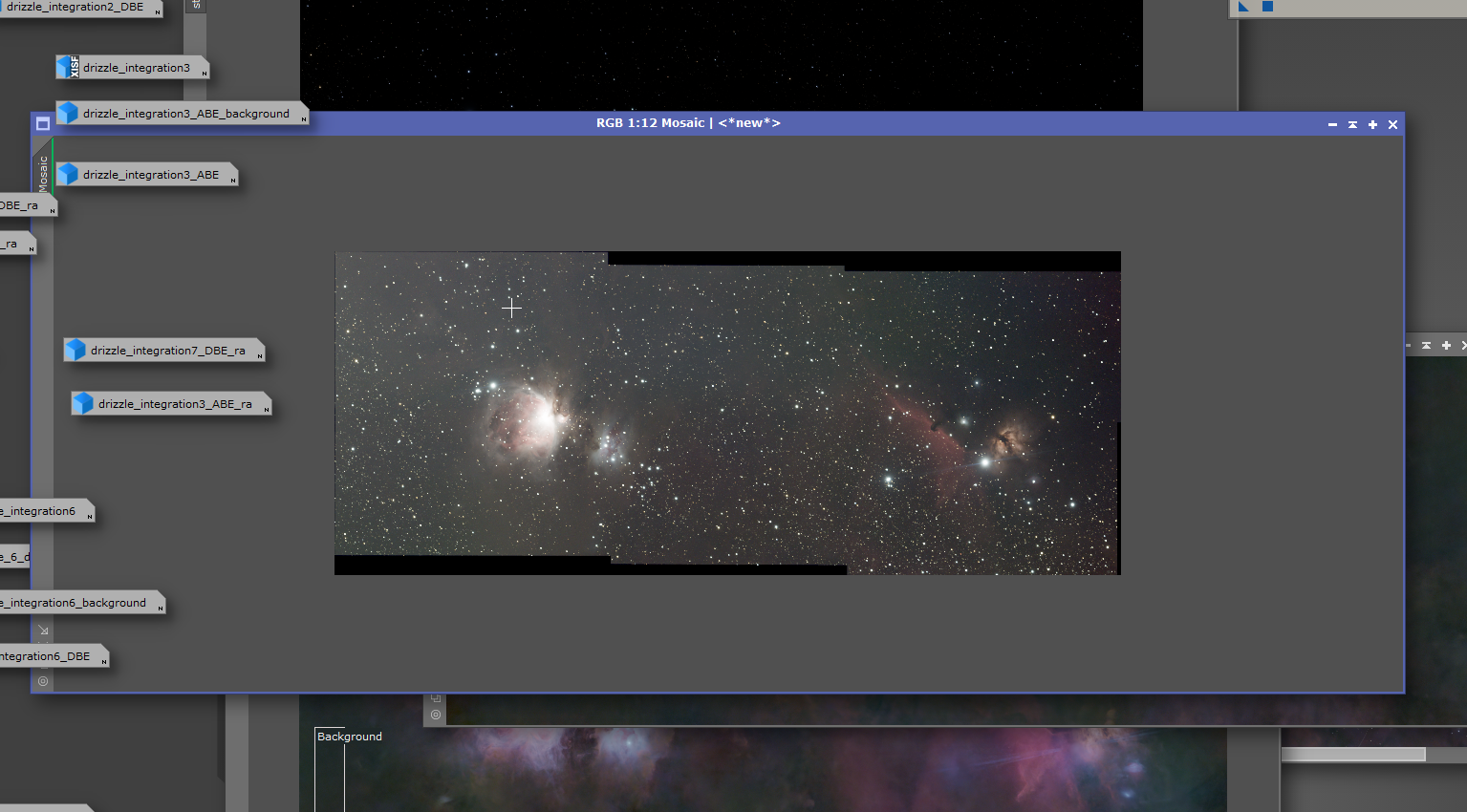
Here is the uncopped raw mosaic:
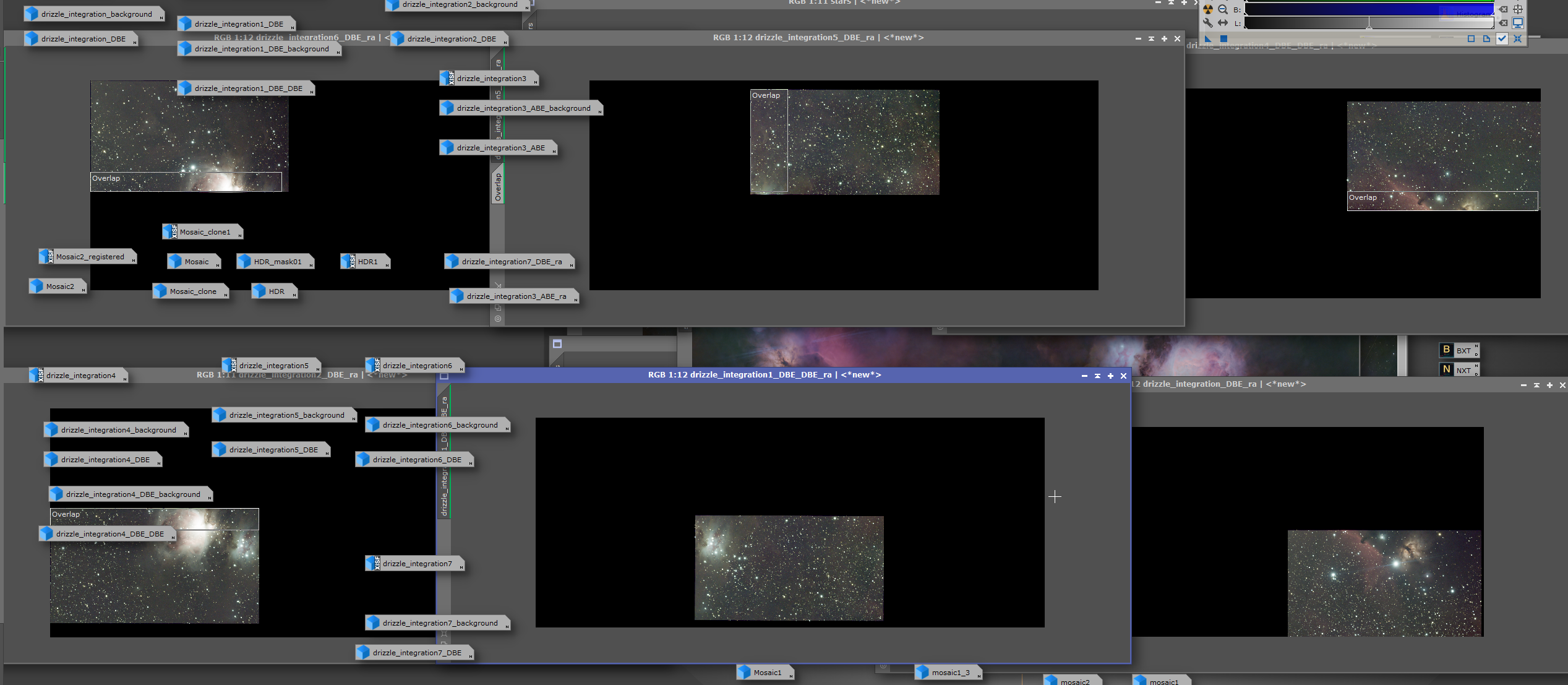
And here the separate frames:
As always, shot with:
- WilliamOptics Redcat 51 WIFD (main telescope)
- Proxisky Ragdoll 17 Pro (mount)
- ZWO ASI585MC Pro (main camera)
- WilliamOptics Uniguide 31mm (guide scope)
- ZWO ASI678MC (guide cam) Gemini Focuser Pro (autofocus)
Software:
And processing:
- Stacking & Processing: Pixinsight
Stacking via WBPP
Individual panels then processed using: DynamicCrop -> DBE/ABE -> SPCC -> MosaicByCoordinates
Mosaic created using: PhotometricMosaic and then HDR data from the 10s frames were merged into it using HDRComposition.
After that, the following was applied to the mosaic: MSGC -> SPCC -> BlurXTerminator -> NoiseXTerminator -> StarXTerminator
This produced a starless photo and the stars separately.
Starless processing: MultiscaleAdaptiveStretch -> GHS -> HDRMutliscaleTransform
Star processing: GHS -> Curves Transformation
Combined into the final photo via PixelMath and rotated via DynamicCrop.
And below is the final photo :)